
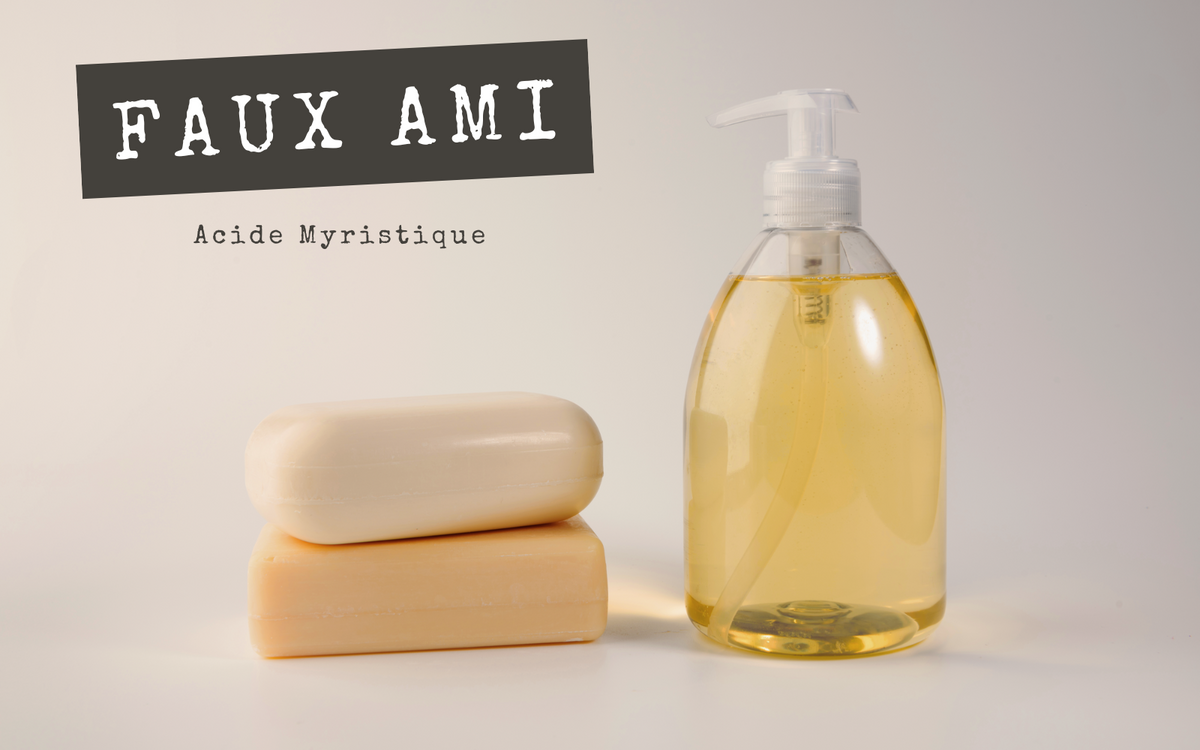
Myristic acid, also called tetradecanonic acid, is a surfactant found in cosmetics as a soap substitute. You know, those famous "soap-free soaps"or even care for the"Neutral pH"...
🔎 Where can it be found?
It is present mainly in shaving product formulations, in creams and lotions and even soaps (solid and liquid).
Bonus: it is also present in food, in dairy products 🧀
🔎 What is its purpose?
Myristic acid serves as an emulsifying surfactant, cleansing agent, and perfumer.
🔎 Why is it bad?
For health
It is considered easily absorbed by the skin and not harmful to it. This is why it is accepted in organic products (even by Nature & Progrès, but only if it is not derived from palm oil).
For the planet
Well, there had to be a downside to this story, and this is where things get complicated... Myristic acid is a saturated fatty acid found naturally in dairy products, oils, and vegetable butters. It can be of natural or synthetic origin. Palm oil and (non-organic) coconut contain a high proportion of it, so it most often comes from these sources... thus contributing to the...exploitation and to the extinction of wildlife.
🔎 How do I replace it?
Is this magic? No, it's S.A.F!
Many vegetable oils have beneficial properties for our skin. Cold process soap making is a relatively simple chemical reaction because it requires little energy and produces a cleansing, moisturizing, and protective product while preserving the properties of the oils used. By avoiding synthetic surfactants that replace soap, you'll know exactly where the oils come from!
Sources :
https://www.francebeaute.fr/sous-rubrique/acide-gras-myristique
https://echa.europa.eu/fr/substance-information/-/substanceinfo/100.008.069